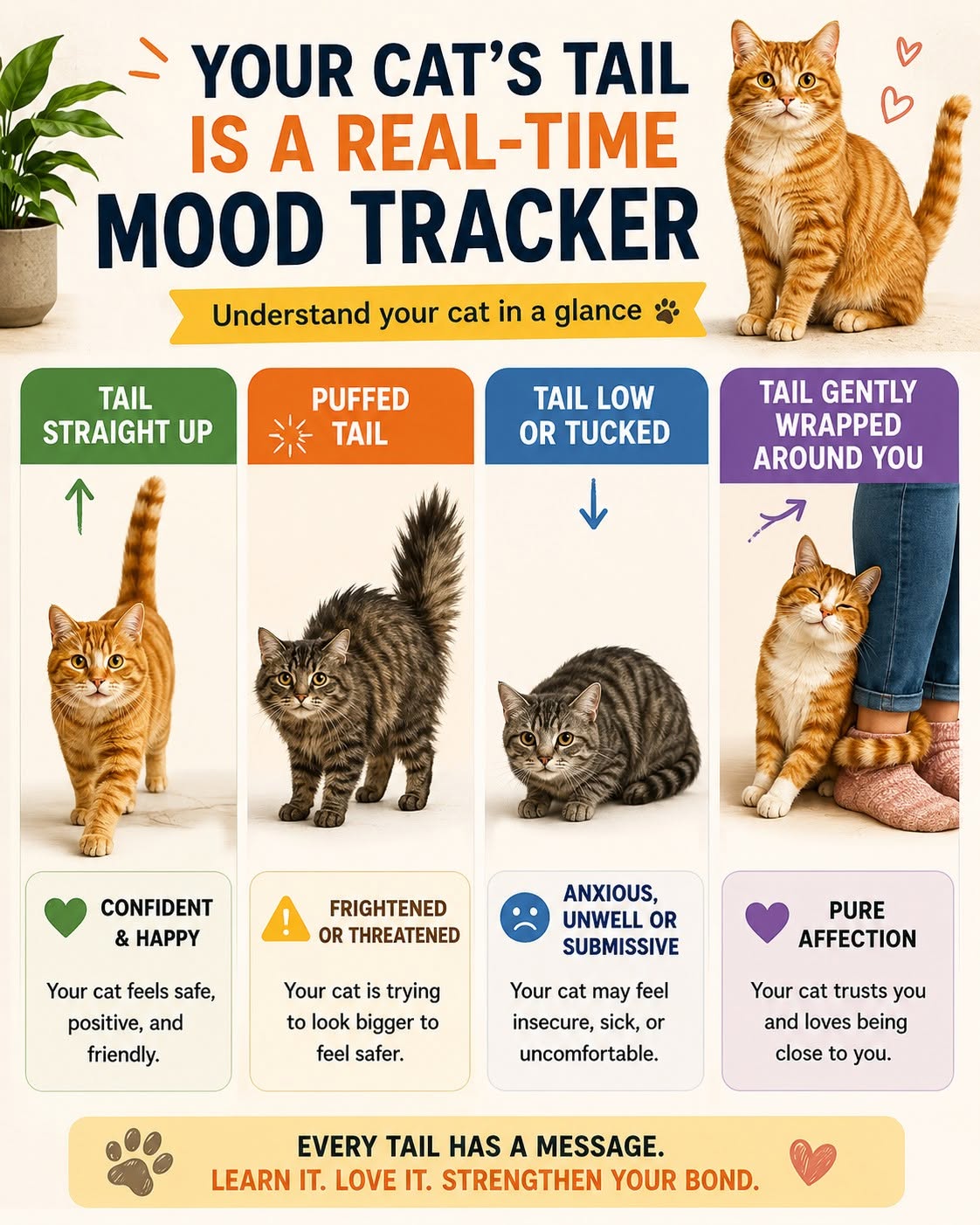
Cats also do the equivalent of an arm around the shoulders.
A cat who sits beside you and drapes their tail across your arm or leg — or loops it around another cat — is doing something quietly enormous. Tail wrapping is an affiliative behavior, the physical vocabulary of “you’re mine and I’m fine with you.” Cats do it with cats they’ve bonded with, and with humans they’ve decided count.
Discover more
Time & Calendars
Children’s
Dictionaries & Encyclopedias
It’s easy to miss because it’s so understated. But if your cat regularly wraps their tail around you, take the compliment. You’re in the inner circle.
The Chase: When the Tail Isn’t Talking
Sometimes the tail isn’t a message at all.
Kittens chase their tails because they’re kittens and everything moves and everything must be caught. Fine. Normal.
Discover more
Cake
Online Image Galleries
Baked Goods
But compulsive tail-chasing in an adult cat — the kind that’s frequent, intense, or hard to interrupt — is different, and it’s the one item on this list that should send you to a vet rather than a blog. It can be linked to boredom or compulsive behavior, but it’s also associated with feline hyperesthesia syndrome, a poorly understood condition involving rippling skin along the back, sudden frantic episodes, and biting at the tail and flank. Pain, skin conditions, parasites, and neurological issues can all present the same way.
The rule of thumb: a kitten pouncing on its own tail is playing. An adult cat attacking its own tail is telling you something is wrong.
The Rule That Makes All of This Work
Here’s the mistake nearly everyone makes, and it’s worth more than every individual signal above:
The tail is not a sentence. It’s a word.
Cats communicate with the whole body at once. A tail lashing while the cat plays with a toy means excitement. The same lash while the cat is cornered by a stranger means something very different. The tail tells you the intensity; the ears, eyes, whiskers, and posture tell you the flavor.
Learn to read the tail alongside three things:
The ears. Forward means engaged. Sideways or flattened — “airplane ears” — means fear or aggression.
The eyes. Pupils blown wide can mean fear or intense arousal. Narrowed pupils in a bright room, with a soft face, means calm. And the slow blink — that lazy, deliberate closing and opening of the eyes — is one of the few gestures where the research is genuinely charming: in controlled studies, cats were more likely to slow-blink back at humans who slow-blinked at them, and were more likely to approach a stranger’s outstretched hand if that stranger had slow-blinked first. Try it tonight.
The body. Loose and long means relaxed. Compressed, crouched, weight shifted back means the cat is preparing to leave.
Put them together and you stop being a person who lives with a mysterious animal. You become a person having a conversation.
Start Tonight
You don’t need to memorize a chart. Do one thing: for the next week, when you walk into a room, look at the tail before you do anything else.
Straight up? Say hello. Go ahead and pet them.
Low and swishing? Give them the room.
Tail wrapped around your ankle while you’re making coffee? Congratulations. Whatever you’re doing, keep doing it.
Your cat has been holding up this flag your entire relationship. They’ve never once expected you to understand it — cats are famously willing to live with our incompetence. But the moment you start reading it, something shifts. The mysterious, aloof, unknowable creature turns out to have been an open book the whole time, written in a language of one moving part.
They’ve been talking. All you have to do is look up.