We spend years decoding dogs. A wagging tail means happy, we say, and we’re mostly right. Then we look at a cat, see the same motion, and get it catastrophically wrong. A wagging cat tail is not a happy cat tail. It may be the last polite warning you get before the claws come out.Anatomy
Here’s the strange truth about cats: they didn’t really evolve to talk to us. Adult cats in the wild barely meow at each other at all. Meowing is something they invented for humans — a learned workaround, a second language spoken with a heavy accent. But the tail? The tail is their mother tongue. It’s honest, it’s involuntary, and it’s running all the time whether you’re paying attention or not.
Once you learn to read it, living with a cat stops feeling like a guessing game.
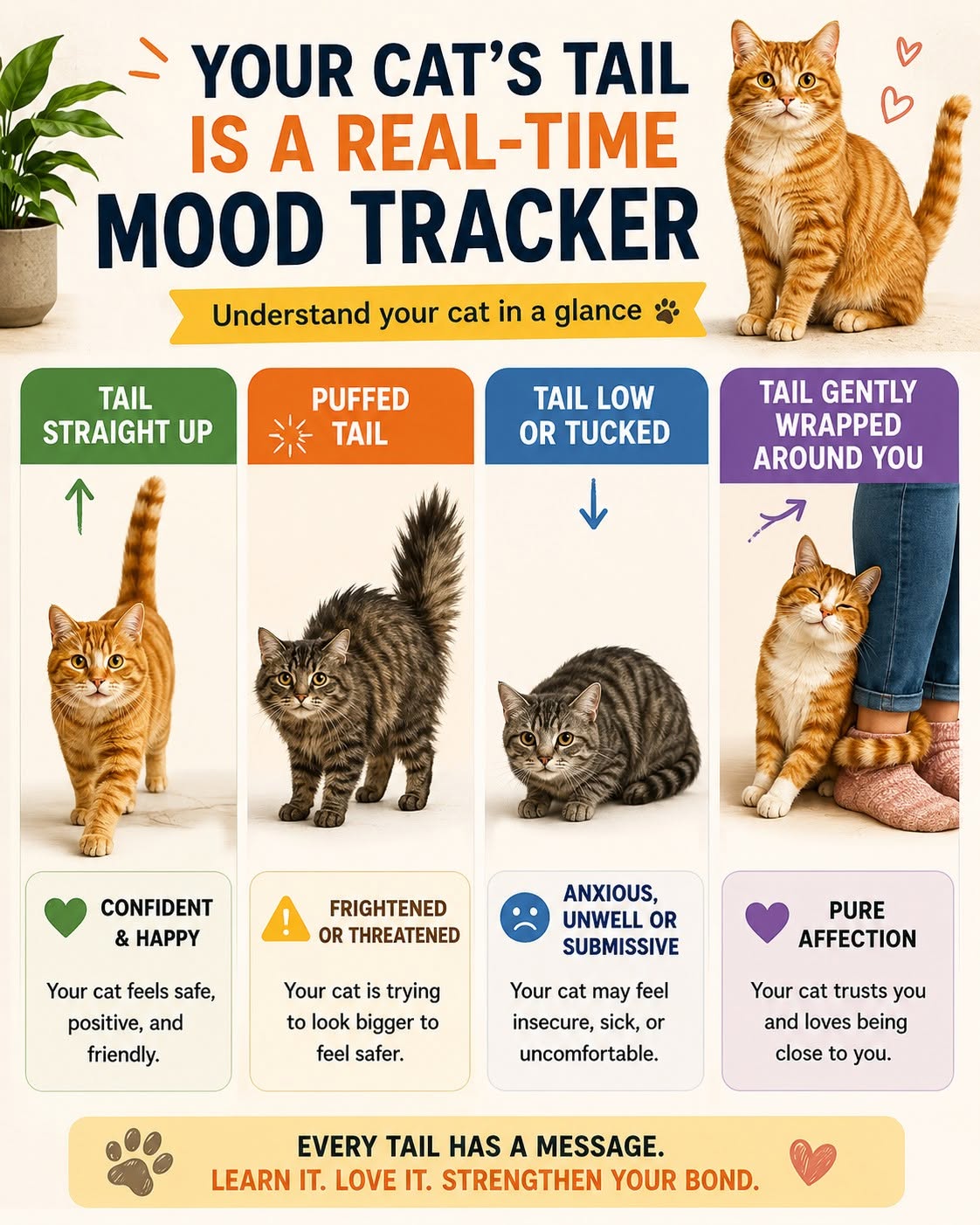
The Tail Up: The Cat Hello
Start with the easiest one, because it’s also the most meaningful.Social Sciences
A cat walks toward you with its tail held straight up like a flagpole, maybe with a soft little hook curling at the tip. This is the single clearest friendly signal in the entire feline repertoire.Dogs
This isn’t folklore. Researchers studying domestic cat behavior found that the vertical tail is a genuine social greeting — cats raise it when approaching a cat or person they intend to interact with peacefully, and the recipient is far more likely to approach in return. In one well-known set of experiments, cats shown a simple silhouette of a cat with a raised tail approached it readily and raised their own tails in response. Shown the same silhouette with a lowered tail, they hesitated, and often didn’t raise their tail at all. A drawing. That’s how hardwired this is.Cats
The kicker: the raised tail traces back to kittenhood. Kittens lift their tails when they approach their mother, partly so she can inspect and clean their rear ends. Your adult cat greeting you with a raised tail is running a program written in the first weeks of its life — one it has chosen to keep running, for you.Wildlife
That little question-mark hook at the top? Read it as an invitation. Your cat is in a good mood and open to whatever happens next.Anatomy
The Wag That Isn’t a Wag
Now the dangerous one.Cats
Your cat is on your lap. You’re petting them. Things seem lovely. And then the tail begins to move — a slow, heavy sweep back and forth against the couch. Thump. Thump.
Your dog-trained brain says: they love this.Anatomy
Your cat is saying: stop.
In cats, a swishing, thumping, or lashing tail signals agitation, conflict, or mounting irritation. Speed and force are your volume dial. A slow, low twitch is mild annoyance or intense concentration. A hard side-to-side lash — especially when the whole tail is moving from the base — means arousal has crossed into something else, and you are running out of time.Cats
This is where the majority of “my cat attacked me for no reason” stories come from. There was a reason. The reason was broadcast for thirty seconds before the bite. Nobody was reading.
There’s a subtler version too, one many owners mistake for affection: petting-induced overstimulation. Your cat genuinely enjoys being stroked, and then, somewhere around the fourth or fortieth stroke, the pleasant sensation flips into too much. The tail starts moving before the skin starts twitching. The tail always goes first.
Discover more
Self-Help & Motivational
Time & Calendars
Babies & Toddlers
The Tip Flick: The Cat Version of a Raised Eyebrow
A cat lying perfectly still, apparently asleep, with just the last inch of the tail flicking — flick… flick… — is not asleep. They’re monitoring. They’ve registered you saying their name and are choosing not to act on it. It’s mild interest, mild irritation, or a bird outside the window.Anatomy
Your Cat’s Tail Is Talking. Are You Listening?
If your cat is watching something intensely — a toy, a bug, a rival cat through the glass — and the tail tip starts twitching, that’s focus tipping into predatory arousal. Anything within paw’s reach is now, briefly, part of the hunt. Including your ankle.
The Puffed Tail: Genuine Fear
The bottle-brush tail is unmistakable and universally understood, mostly because Halloween decorations have been running the ad campaign for a century.
It’s caused by piloerection — the same reflex that gives you goosebumps, driven by adrenaline, standing every hair on end. The purpose is simple: make the cat look bigger than it is. It’s paired with an arched back and a sideways stance, which is not a swagger but a way of maximizing apparent size.
Crucially, this is involuntary. Your cat cannot fake it and cannot suppress it. A puffed tail is not a bluff — it’s a nervous system in genuine alarm. Whatever caused it, the fear is real, even if the cause is a cucumber.
Discover more
Photo & Image Sharing
Child Care
Birthdays & Name Days
The Tucked Tail: Fear’s Quiet Cousin
The opposite of puffing is folding.
A tail held low, pressed tight to the body, or curled underneath while the cat crouches, is submission, anxiety, or a desire to disappear. Where puffing shouts, tucking hides. It’s the response of a cat who has decided that looking big is a losing strategy and vanishing is a better one.
Watch for this at the vet, during a house move, when a stranger’s over, or when a new cat arrives. And watch for it becoming habitual. A cat who is chronically low-tailed in their own home isn’t shy. They’re stressed, and something in the environment is doing it.
Pregnancy & Maternity
The Wrap: The Tail Hug…